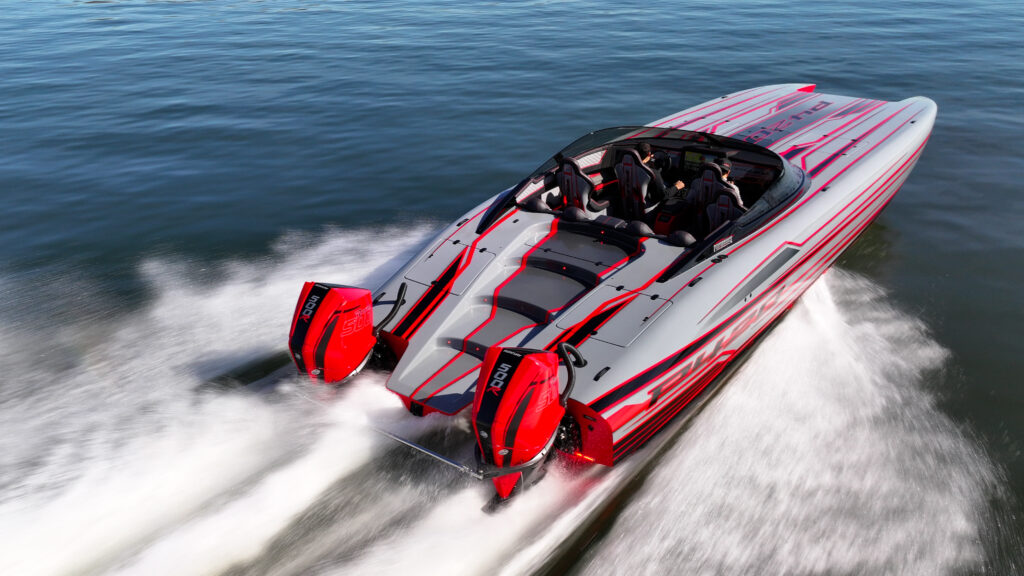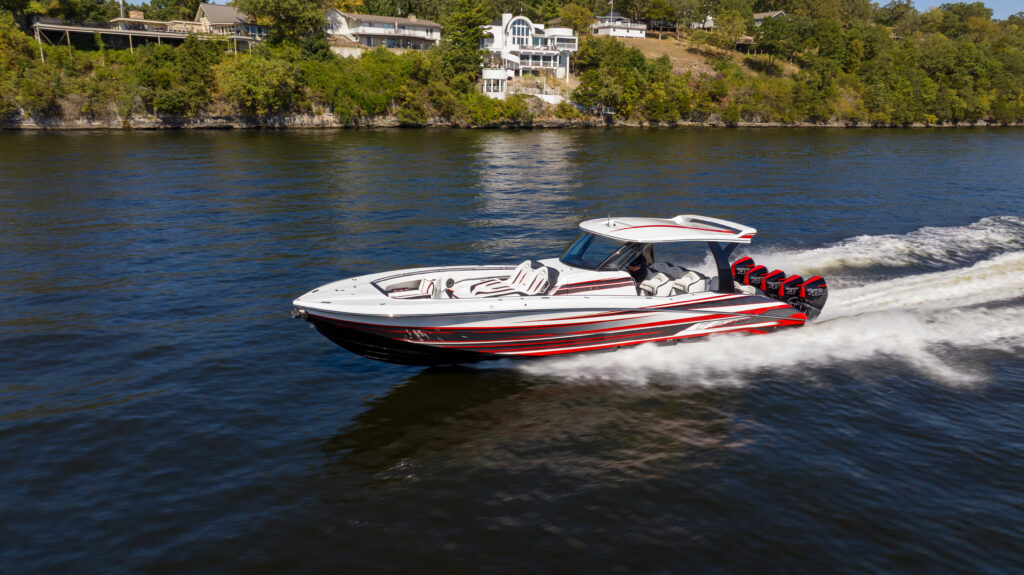
If you run a Mercury Racing outboard the way most performance boaters do, at sustained high speed and often at wide-open throttle, plan on Mercury’s heavy-use service intervals. That means changing the engine oil and gear lube as often as every 25 hours, with a full service every 100 hours or once a year, whichever comes first. That’s the real answer to the outboard service interval question for the 300R, 400R, 425R, and 500R you see on the transoms of today’s performance cats and center consoles. The standard 100-hour schedule is written for moderate use. Mercury Racing engines are built to run hard, and most of them do.
As a Platinum Mercury Racing dealer with service centers at Lake of the Ozarks and in Fort Lauderdale, we see the difference service timing makes. When fluids get changed on the heavy-use schedule, the engine’s internals still look healthy at 500 hours. When owners wait for the 100-hour mark, we see worn gearcases, broken-down oil, and repairs that could have been avoided. Here is how we think about maintenance for high-horsepower outboards, starting with the intervals that fit how you actually run your boat.
Key Takeaways
- If you run at sustained high speed, don’t wait for the 100-hour or 12-month mark. Mercury’s heavy-use outboard service interval calls for changing the engine oil and gear lube about every 25 hours, and that’s the schedule most performance boaters should be on.
- Engines run at sustained wide-open throttle, which describes most Mercury Racing applications, follow Mercury’s heavy-use schedule for engine oil and gear lube.
- Heat and load at speed break down oil and gear lube fast, and the gearcase takes the most punishment. Fresh fluids are the cheapest protection for an expensive engine.
- Certified Mercury Racing technicians, OEM parts, and documented service on the right schedule protect both your engine and your warranty.
Recommended Outboard Service Intervals by Engine Type
Mercury publishes two maintenance schedules for its outboards. The standard schedule calls for service every 100 hours or once a year, whichever comes first. The heavy-use schedule applies to engines run at sustained high speed and wide-open throttle, and it shortens the intervals for engine oil and gear lube. Mercury Racing outboards are built to run at the top of their range, and most of the ones we service spend most of their time there. For our customers, the heavy-use schedule is the one that applies.
High speed and heavy loads break down oil and gear lube much faster. Gearcase temperatures climb, oil shears, and wear particles build up long before the hour meter reaches 100. Waiting for the standard interval on a boat that runs hard every weekend means running on worn fluids for most of the season.
Here is the schedule we recommend for the engines we service most:
- Mercury Racing V10 outboards (400R and 500R): break-in inspection around 20 hours. If you run at sustained high speed, change the engine oil and gear lube every 25 hours. Book a full service every 100 hours or once a year, whichever comes first. The 500R’s M-Drive gearcase works especially hard at speed, so the gear lube interval is the one not to stretch.
- Mercury Racing V8 outboards (300R and 425R): break-in inspection around 20 hours. For hard running, change the engine oil and gear lube every 25 hours. Book a full service every 100 hours or once a year, and a deeper service around 300 hours or three years.
- Mercury Verado and FourStroke outboards: the standard 100-hour or annual service is the baseline, with 300-hour and 500-hour milestones for deeper inspections and wear parts. Boats that cruise at high RPM for long stretches should change fluids more often.
- Multi-engine setups (triples, quads, and quints): the same intervals apply to every engine. Service them together so hours, fluids, and wear stay matched across the transom.
Calendar time still counts. A lake boat that logs 40 hours a year still needs its annual service, because oil breaks down, gear lube picks up moisture, and rubber ages whether the engine runs or not. Your owner’s manual has the exact heavy-use intervals for your engine and model year. Our service team can help you match the right schedule to how you actually run your boat.
What Happens at Each Service Milestone
A high-performance outboard runs on two kinds of service. Fluid services happen often and keep the engine protected while you run hard. Full services happen less often and cover everything else. Knowing what each one includes helps you plan downtime and budget, and it makes it easier to spot when something has been missed.
Break-In Inspection
The first hours on a new engine are when internal parts seat against each other, and that process leaves fine metal particles in the oil and gear lube. The break-in visit gets that debris out early and gives a technician a first look at the installation while everything is fresh.
- Engine oil and filter change, plus a gear lube drain and inspection
- Torque checks on engine mounts, steering, and critical fasteners
- Diagnostic scan for fault codes and a review of break-in operating data
- Rigging, propeller, and trim inspection
25-Hour Heavy-Use Fluid Service
If you run at sustained high speed, this is the service you’ll book most often. It’s a focused visit built around the fluids that take the most abuse at wide-open throttle, and it’s quick enough to fit between weekends on the water.
- Engine oil and filter change
- Gear lube drain and refill with new drain seals
- Inspection of the drained gear lube for water intrusion or metal, which are early signs of a failing seal or internal wear
- A quick visual check of the propeller, lower unit, and anything that looks out of place
The drained fluids are some of the best information a technician gets about how the engine is holding up. Milky gear lube or metal on the drain magnet at 25 hours is a cheap fix. The same problem found at 100 hours can mean a gearcase rebuild.
100-Hour or Annual Full Service
The full service covers everything, not just the fluids. Even if you change fluids every 25 hours, you still need this visit every 100 hours or once a year, whichever comes first.
- Engine oil and filter change, plus gear lube change with new drain seals
- Fuel filter replacement and fuel system inspection
- Anode inspection and replacement as needed
- Lubrication of steering, tilt, and driveshaft splines
- Propeller removal, propeller shaft inspection, and grease
- Battery, wiring, and connection checks
- Full diagnostic scan and software review with Mercury dealer diagnostics
What’s the Difference Between a 25-Hour Service and a Full Annual Service?
The 25-hour service protects the parts that wear fastest when you run hard: the engine oil and the gearcase. It’s short, focused, and meant to be repeated through the season. The full annual service is the complete checkup. It covers the fuel system, corrosion protection, steering and tilt, electrical connections, and the diagnostics that catch problems no fluid change will show.
One doesn’t replace the other. A boat that gets fluid services every 25 hours but skips the annual service can still develop fuel, corrosion, or electrical problems. A boat that gets only the annual service runs on worn-out fluids for most of the season. Performance boaters need both.
300-Hour or Three-Year Service
The 300-hour service adds the wear parts that fail quietly with time. Depending on the engine, that means spark plugs, the water pump impeller, thermostats, a closer look at the cooling system, and inspection of belts and supercharger components. On a high-horsepower outboard, a tired impeller is one of the most common paths to an overheat, so this is not a visit to push back. Hard-running boats reach 300 hours faster than most owners expect, so keep an eye on the hour meter.
Pre-Season and End-of-Season Service
We recommend a pre-season inspection for lake boats coming out of storage, and an end-of-season service with winterization before the boat is put away. Year-round saltwater boats in South Florida get extra attention on corrosion protection, anodes, and cooling system flushes.
Signs Your Outboard Needs Service Sooner
Intervals are a schedule, not a guarantee. If you notice any of the following, do not wait for the next milestone:
- Overheat alarms or a weak telltale stream. Often the first sign of a worn impeller or a blocked cooling passage.
- Milky or metallic gear lube. Milky lube means water is getting past a seal. Metal flakes point to internal wear.
- Loss of top speed or RPM. A drop at wide-open throttle can signal fuel delivery, ignition, or propeller problems.
- Rough idle, hesitation, or misfires. Fuel quality, injectors, or ignition components may need attention.
- Warning codes or Guardian mode. When the engine limits its own power to protect itself, it is telling you something.
- New vibration, noise, or steering feedback. Can come from prop damage, mounts, or steering components.
- Visible corrosion or fluid leaks. Especially common on boats that live in saltwater.
- A hard grounding or strike. Any impact to the lower unit deserves an inspection before the next run.
Catching these early is almost always cheaper than repairing the damage they cause at 100 mph.
Why Certified Service Matters for High-Performance Engines
A Mercury Racing outboard is not a standard outboard with more horsepower. Supercharged and high-output powerheads, racing gearcases, and complex multi-engine rigging all demand technicians who work on these setups every day. Generic service can follow the checklist and still miss what matters on a 425R or a 500R.
As a Platinum Mercury Racing dealer and authorized Mercury Racing warranty center, Performance Boat Center brings that experience to every service visit:
- Certified Mercury Racing outboard technicians who specialize in high-horsepower applications
- OEM Mercury Racing parts matched to your engine and model year
- Dealer-level diagnostics that read the full picture of how your engine has been running
- Documented service records that support warranty claims and help resale value
- Two service centers, Osage Beach on the Lake of the Ozarks and Fort Lauderdale in South Florida, plus mobile service
Whether you need a break-in inspection, your 100-hour service, or a full repower, our team keeps your boat ready to run. Learn more about our certified boat service and repairs.
FAQs
How often should you service a boat engine?
It depends on how you run the boat. Performance outboards that spend most of their time at sustained high speed or wide-open throttle should have the engine oil and gear lube changed about every 25 hours, following Mercury’s heavy-use schedule. The standard schedule of every 100 hours or once a year is written for moderate use, and most performance boats don’t run that way. Either way, you’ll still need a full service at least once a year.
What is the Mercury outboard maintenance schedule?
Mercury publishes two schedules. The standard one calls for service every 100 hours or once a year, with deeper milestones at 300 hours or three years. The heavy-use schedule is for engines run at sustained high speed, like most Mercury Racing applications, and calls for engine oil and gear lube changes about every 25 hours. For performance boaters, the heavy-use schedule is the one to follow. Your owner’s manual has the exact intervals for your engine and model year.
Do I need a 20-hour service on a new Mercury Racing outboard?
We recommend a break-in inspection around 20 hours on every new engine. It removes early wear debris from the oil and gear lube and lets a technician check rigging and fasteners before small issues become big ones.
Does skipping service affect my Mercury Racing warranty?
It can. Warranty coverage depends on proper maintenance, and documented service at the recommended intervals is the clearest proof. Having your engine serviced at an authorized Mercury Racing warranty center keeps that record in order.
Schedule Your Mercury Racing Service
The right outboard service interval is the one that matches how you run your boat. If you are approaching 100 hours, coming up on a new season, or noticing any of the warning signs above, our certified technicians are ready to help.
Schedule service at our Lake of the Ozarks or Fort Lauderdale service center, or call Osage Beach at 573-873-2300 or Fort Lauderdale at 954-237-0332.